How do shared rules interact with different moral profiles?
A multi-agent sandbox studies how institutional rules and agent composition shape behavior in a shared environment.
Conceptual illustration of an artificial-agent simulation. This is not experimental data or a model of human populations.
Study design
Agents with illustrative moral profiles interact in a co-living environment with episodic memory and contribution feedback. We compare 15 group compositions under four institutional rule regimes.
Change the rules. Keep the shared world.
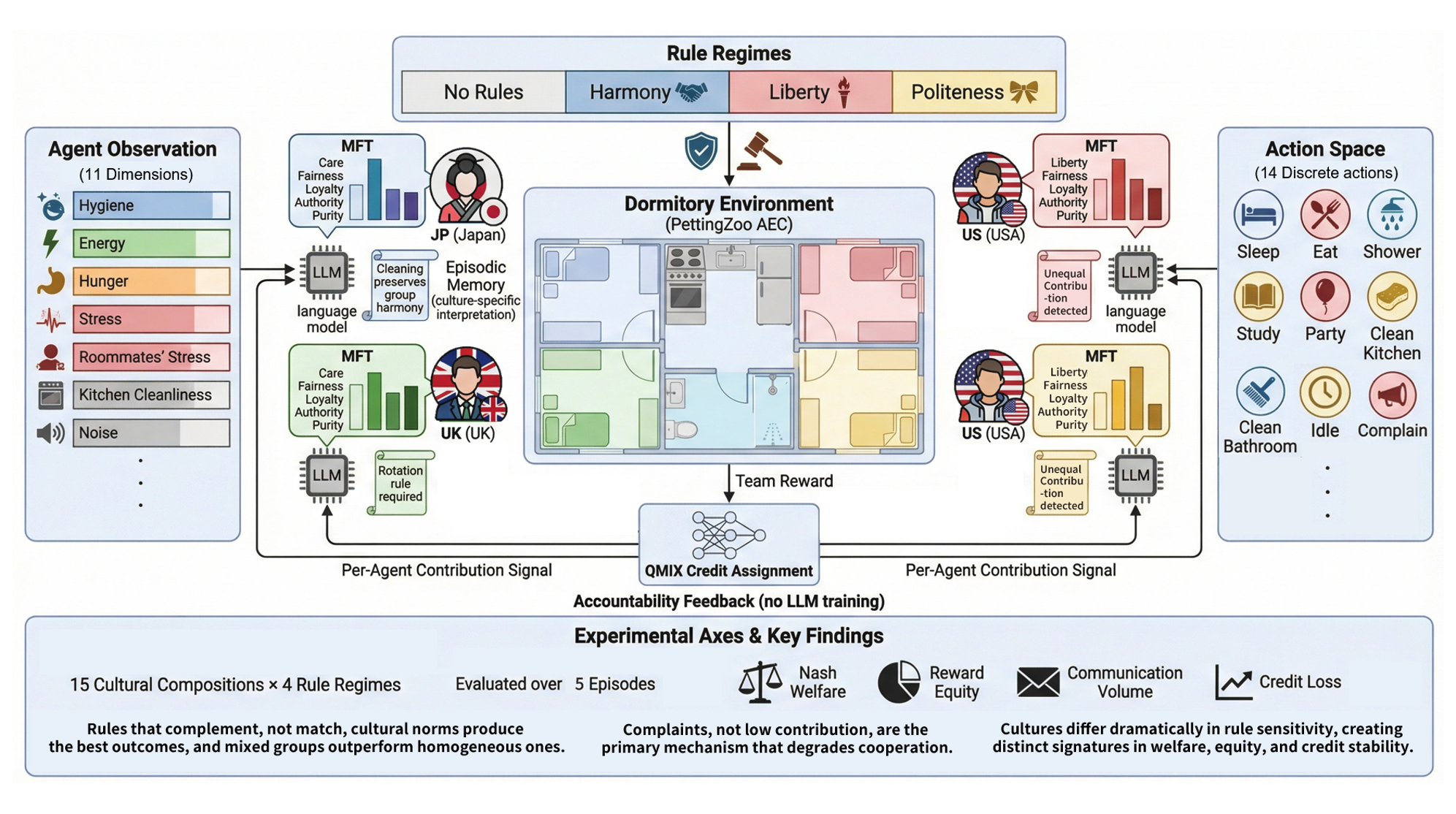
The figure separates population composition from institutional rules in the co-living simulation. Its profile labels and outcomes describe artificial agents, not validated models of human cultures.
Two experimental choices
The top row gives four rule regimes. Group composition is varied separately across 15 configurations.
Trace the consequences
Observations lead to actions in the shared environment. Rewards and contribution feedback connect those actions to later behavior.
Lee, Ryu, Kim & Yoo · CHI PoliSim 2026 · Figure 1 from the workshop paper. Paper ↗
Findings
The framework allows composition and shared rules to be varied separately while tracking welfare, equity, communication, and credit-assignment stability.
The workshop study is a simulation of artificial agents. Profile labels and simulated outcomes should not be interpreted as validated models of human cultures or evidence for real-world policy.
Manners Maketh MAN: Multi-Agent Norm Dynamics under Cultural Moral Values
Keeheon Lee, Kunhee Ryu, Minje Kim, and Hogyun Yoo
CHI 2026 · PoliSim Workshop · Workshop
BibTeX citation
@misc{lee2026normdynamics,
  title={Manners Maketh MAN: Multi-Agent Norm Dynamics under Cultural Moral Values},
  author={Lee, Keeheon and Ryu, Kunhee and Kim, Minje and Yoo, Hogyun},
  year={2026},
  note={PoliSim Workshop at CHI 2026}
}