How do different moral priorities affect cooperation among artificial agents?
A shared-space simulation studies the interaction of moral profiles, episodic memory, and feedback on individual contributions.
Conceptual illustration of an artificial-agent simulation. This is not experimental data or a model of human populations.
Study design
Four LLM agents interact in a shared-dormitory simulation. Illustrative profiles based on Moral Foundations Theory shape their prompts and memories. A QMIX module provides contribution feedback. The study compares 15 compositions of the four-agent group.
Different priorities inside one shared dormitory.
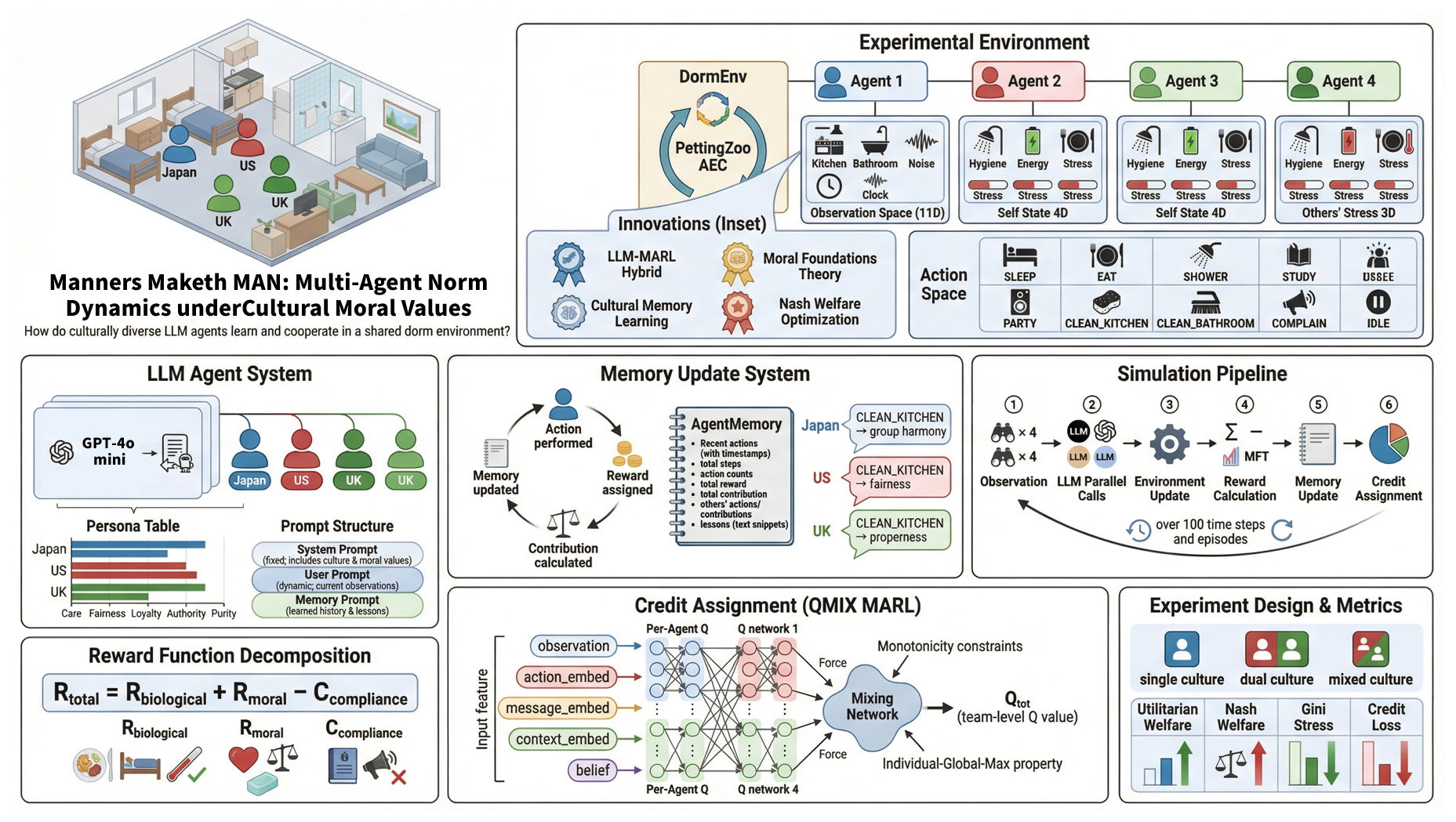
The architecture connects profile-conditioned actions, shared consequences, memory, and contribution feedback. Country-derived labels identify the paper’s artificial profile prompts; they are not claims about real populations.
Experience becomes memory
Action histories, rewards, and profile-specific lessons feed into subsequent decisions.
Credit returns to the agent
QMIX decomposes team value into individual contribution signals. The experiment varies 15 group compositions.
Lee, Ryu & Yoo · AAMAS ASI 2026 · Figure 1 from the non-archival workshop paper. Paper ↗
Findings
In this simulation, profile composition affects collective welfare, communication, and the stability of credit assignment. Memory and feedback create a way to study how differing priorities influence repeated interaction.
This is a non-archival workshop poster paper. The agents and profiles are an artificial experimental setting. The results do not characterize real national populations or justify decisions about grouping people.
Manners Maketh MAN: Moral-Profile Diversity and Cooperative Dynamics in LLM-Based Multi-Agent Simulation
Keeheon Lee, Kunhee Ryu, and Hogyun Yoo
AAMAS 2026 · ASI Workshop · Workshop
BibTeX citation
@misc{lee2026moralprofiles,
  title={Manners Maketh MAN: Moral-Profile Diversity and Cooperative Dynamics in LLM-Based Multi-Agent Simulation},
  author={Lee, Keeheon and Ryu, Kunhee and Yoo, Hogyun},
  year={2026},
  note={ASI Workshop at AAMAS 2026. Non-archival poster paper}
}