How do people work through evidence to decide whether to rely on AI?
An exploratory study follows how people inspect, revisit, and interpret evidence while evaluating an AI-generated answer.
Conceptual summary of the verification loop, based on the CHI EA 2026 paper.
Study design
We hold the AI-generated answer constant while varying how people access supporting evidence across three transparency conditions. An exploratory mixed-methods pilot with three medically trained participants combines interaction logs, semi-structured interviews, and qualitative analysis.
Transparency meets a person’s verification process.
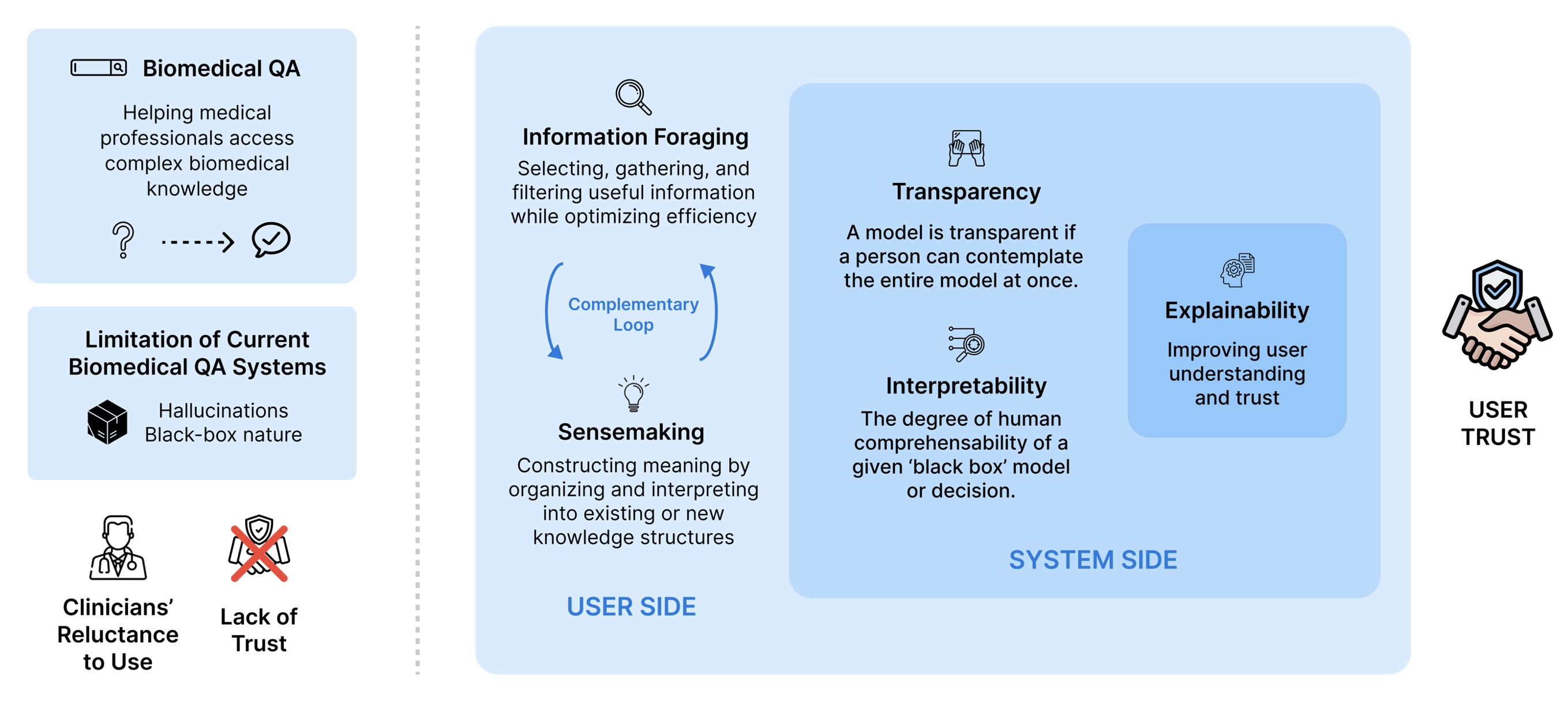
The conceptual framework places information foraging and sensemaking on the user side. Interface transparency supports that process; it does not directly determine whether an answer should be trusted.
Follow the loop
People seek evidence, interpret it, and return for more. The central loop is the organizing idea of the paper.
Read it as a framework
The three-participant pilot explores this process. The diagram is a conceptual account, not an estimated causal model.
Ryu et al. · CHI EA 2026 · Figure 1, reproduced unchanged. Paper ↗ CC BY-NC-ND 4.0 ↗
Findings
The pilot illustrates how the structure of evidence access shapes verification. Participants selectively inspected specific evidence, revisited claims, and deferred or rejected answers when support appeared incomplete. These observations motivate treating trust as an ongoing process of checking and interpretation.
This is a three-participant exploratory pilot around a single verification-critical question. It supports a conceptual account and study design, rather than population-level claims or statistical conclusions about clinicians.
Can Transparency Help Clinicians Trust AI? Reframing Trust as an Information Foraging and Sensemaking Loop
Kunhee Ryu, Heeyoung (Emily) Ghang, Sechang Chon, Keeheon Lee, and Younah Kang
CHI EA 2026 · Published
BibTeX citation
@inproceedings{ryu2026transparency,
  title={Can Transparency Help Clinicians Trust AI? Reframing Trust as an Information Foraging and Sensemaking Loop},
  author={Ryu, Kunhee and Ghang, Heeyoung and Chon, Sechang and Lee, Keeheon and Kang, Younah},
  booktitle={Extended Abstracts of CHI 2026},
  year={2026},
  doi={10.1145/3772363.3798817}
}