How can agents combine evidence without losing its provenance?
Study-centered agents extract, critique, and revise evidence before a statistical module synthesizes the results.
Conceptual workflow. Agents verify evidence; a separate module performs statistical pooling.
Study design
One agent is assigned to each primary study. Agents extract page-anchored data, exchange critiques, and revise disputed entries under a shared protocol. A separate statistical module performs pooling. We compare this workflow with a single-LLM pipeline using eight cardiology meta-analyses comprising 114 primary studies.
From study-level evidence to a pooled estimate.
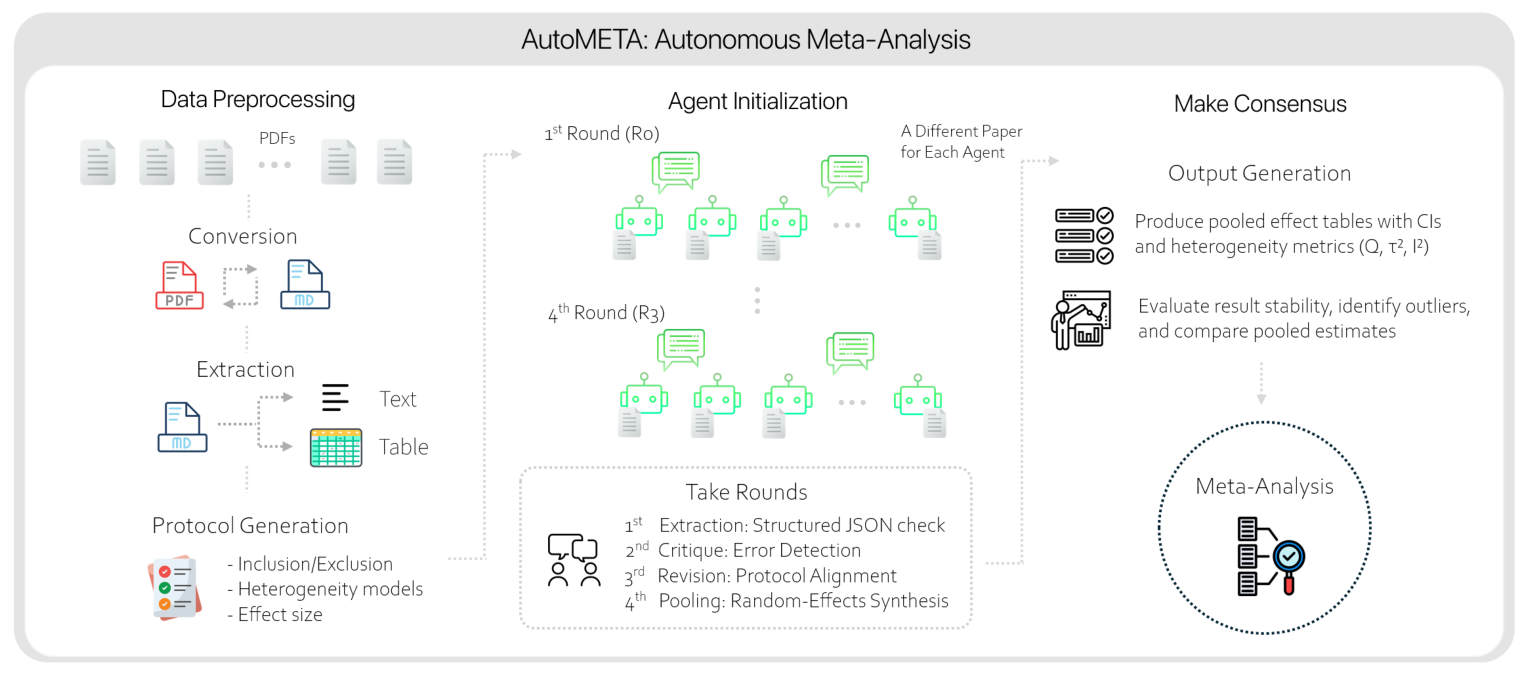
Figure 2 shows how study-centered agents extract and check evidence before a separate statistical module combines the results. Figure content is unchanged; surrounding page material was cropped.
Keep the study attached
Each agent works with one primary study and preserves page-anchored evidence for its extracted entries.
Check before pooling
Agents critique and revise disputed entries. Statistical synthesis is a separate step after that verification.
Lee & Ryu · AAMAS 2026 · Figure 2. Paper ↗ CC BY 4.0 ↗
Findings
Median relative effect-size error against human-authored references is 6.4% for AutoMETA, compared with 34.0% for the single-LLM baseline under the same protocol. Ablations show that critique and protocol enforcement both contribute to the result.
The evaluation uses a specific cardiology corpus. Stricter verification can exclude more studies and destabilize estimates of between-study variation. Agreement on a pooled estimate does not by itself establish complete or unbiased evidence coverage.
AutoMETA: A Multi-Agent LLM System for Autonomous Meta-Analysis
Keeheon Lee and Kunhee Ryu
AAMAS 2026 · Main track · Published
BibTeX citation
@inproceedings{lee2026autometa,
  title={AutoMETA: A Multi-Agent LLM System for Autonomous Meta-Analysis},
  author={Lee, Keeheon and Ryu, Kunhee},
  booktitle={Proceedings of AAMAS 2026},
  pages={2968--2977},
  year={2026},
  doi={10.65109/HXKA2256}
}