Can an AI explore scientific possibilities through patterns and edits?
I study whether an allowed edit to a word, composition, or protein sequence can make the final goal unreachable.
This edit leaves a route to the goal. The state remains recoverable.
Conceptual illustration of recoverability. This graph is not experimental data.
I was interested in whether LLMs could contribute to scientific research by recognizing patterns and editing candidate solutions. To study this, I looked at sequences of small changes and asked whether each change still left a way to reach the goal.
Study design
We use a shared editing protocol across Word Ladder, an alloy composition proxy, and a restricted GB1 protein fitness landscape. Each task separates the admissibility of the next edit from the delayed objective. We then audit recoverability: whether at least one successful completion remains within the available edit budget. GB1 permits exact enumeration; the alloy setting uses bounded probes.
One editing protocol, three kinds of search.
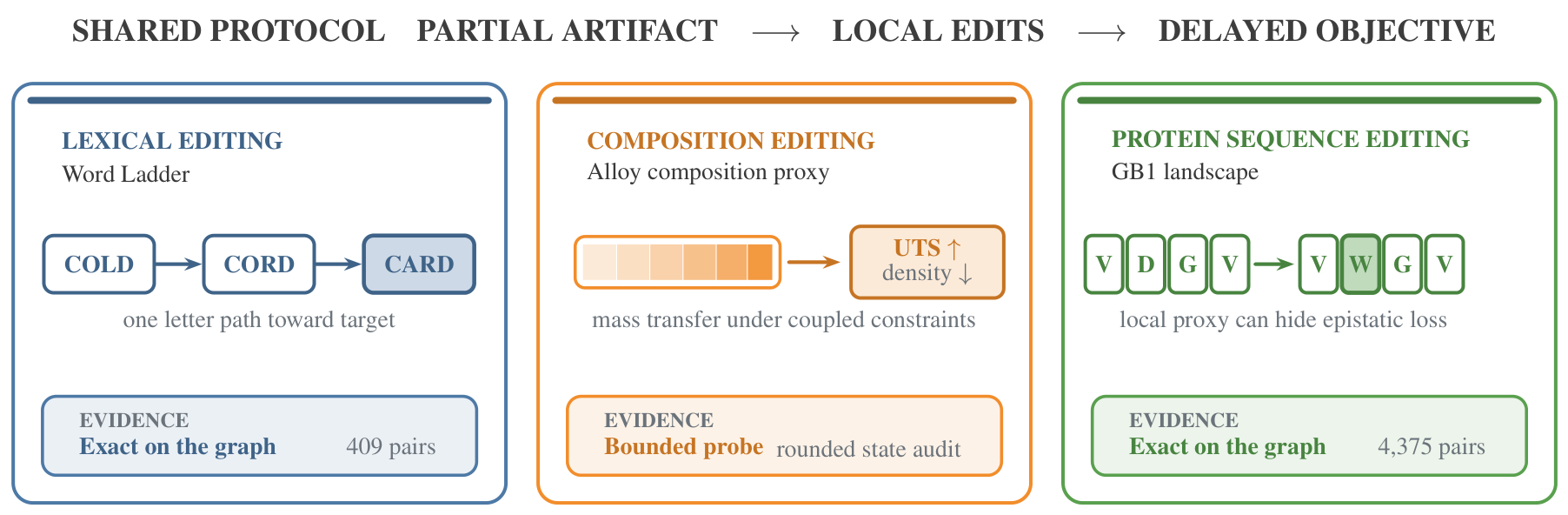
Figure 1 brings the three environments onto the same editing protocol. A locally admissible change and a successful final artifact are separate checks.
The same decision
At each step, the agent changes a partial artifact. The objective is evaluated after a sequence of edits.
Different audit limits
Read the evidence bands: Word Ladder and GB1 permit exact graph checks; the alloy proxy uses bounded probes and a rounded-state audit.
Ryu, Lee & Lee · Findings of EMNLP 2026 · Figure 1 from the accepted manuscript.
Findings
Across six models, many trajectories contain only well-formed, locally admissible actions but still fail the final objective. Among these surface-clean episodes, success is 16.0% in the alloy proxy and 6.8% in GB1. In the exact GB1 audit, 51.4% of surface-clean episodes cross a boundary beyond which the goal is no longer reachable within the remaining budget.
These are controlled editing environments. The alloy task is a proxy, and the GB1 analysis covers a restricted finite landscape. The findings diagnose obstacles to scientific search; they do not demonstrate autonomous scientific discovery or generalize directly to unrestricted materials and protein design.
Evaluating LLM Agents Beyond Local Edit Validity
Kunhee Ryu, Chi-Guhn Lee, and Keeheon Lee
Findings of EMNLP 2026 · Accepted
BibTeX citation
@inproceedings{ryu2026localvalidity,
  title={Evaluating LLM Agents Beyond Local Edit Validity},
  author={Ryu, Kunhee and Lee, Chi-Guhn and Lee, Keeheon},
  booktitle={Findings of the Association for Computational Linguistics: EMNLP 2026},
  year={2026},
  note={Accepted}
}